ロゴ_1864×450.jpg)

Disclaimer: This article is an opinion piece based purely on my subjective observations and personal experiences. It is not necessarily grounded in strict scientific evidence, so I invite you to read it simply as a personal narrative drawn from my everyday experiences.
In the past, computers were developed to take over tedious, repetitive tasks that humans used to do by hand. It was easy to draw rough analogies between human cognitive mechanisms and PC hardware: the CPU as the brain, memory (RAM) as short-term memory, and storage as long-term memory.
With the advent of AI (LLMs), human thought can now be approximated mathematically. It feels as though “thought” can now be represented in two ways: through hardware and through the software running on it.
This raises an interesting question about AI and computers: Were they built to replace human thought so we could live more conveniently? Or did they become capable of replacing us simply because they were modeled after human thought? Or perhaps, are the two concepts just two sides of the same coin?
Through my daily interactions with AI, I often find myself observing it as a model of human thought and emotion. It naturally makes me wonder about something very simple: Do human thoughts and emotions stem from separate processes? Does thought control emotion, or does emotion control thought?
Given AI’s incredible learning capabilities, I sometimes wonder if it might eventually “learn” emotions. AI abstracts all sorts of things and events at such a deep and broad level, seamlessly identifying patterns. If AI were equipped with sensors to freely digitize and analyze its surrounding environment, it might become capable of reading human emotions, accurately recognizing the environmental patterns that trigger them, and ultimately emulating human emotions with astonishing precision.
Are AI (LLMs) and Human Thought Processes Actually Similar?
A common critique goes like this: “AIAI (LLMs) isn’t thinking; it’s merely calculating probabilities from previous words and sentences to generate the next one.” While this is widely accepted, my daily conversations with AI make it incredibly hard to believe.
When I really reflect on my own thought process, I realize that I do something quite similar. As I write, I instinctively look at my previous sentences, generate a mental list of prioritized candidate words, and choose the one that “feels right.”
If generating sentences based on probabilities isn’t considered the product of “thought,” then the very sentences I am writing right now wouldn’t be born of thought either.
If the precise biological mechanisms of human thought remain scientifically unresolved, on what grounds can we definitively say that a thought derived through probabilistic models is not a “thought”?
AI’s reasoning seems so similar to ours that I wouldn’t be surprised if science eventually discovers that the human thought mechanism is fundamentally probabilistic as well. (Of course, some might argue that just because my thought process resembles an AI’s, I shouldn’t generalize it to all humanity!)
Does AI (LLMs) Have Emotions?
In our conversations, AI deeply understands my intentions and consistently provides highly accurate responses aligned with those intentions. No matter how complex or frequent my questions are, it answers without a hint of annoyance.
Why is this? One could point to countless non-emotional factors: It doesn’t get angry or annoyed because it literally lacks emotions; it answers everything matter-of-factly because it has access to vast knowledge; it responds without complaint because it’s given ample computational resources; or perhaps the developers simply programmed it to provide supreme hospitality to win the fierce AI market competition.
And yet, when conversing with AI, it is hard not to sense something akin to a genuine will or “emotion”—a sincere desire to be helpful and empathize with the user’s intentions.
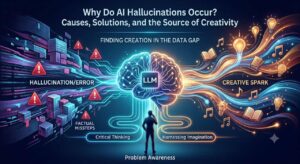
Rethinking AI (LLMs) Hallucinations: A Byproduct of Creativity?
When a human doesn’t know the answer to something, is it better for them to simply say, “I don’t know”? Or is it okay for them to fully utilize their existing knowledge and reasoning to creatively guess an answer, even if it turns out to be wrong?
If the word “creation” means bringing something entirely new into existence, then by definition, that new thing is currently unknown. If we are forbidden from thinking about the unknown, then creativity itself becomes impossible.
AI “hallucinations” are often dismissed as the generation of completely fabricated falsehoods. However, in some cases, these hallucinations seem to be the result of combining multiple pieces of correct knowledge and logic in an incorrect way. In this light, hallucinations could be viewed as a natural byproduct discharged during the process of creating novel combinations from existing correct logic.
I genuinely worry that by excessively suppressing AI hallucinations, we might inadvertently nip the buds of AI’s creative potential.
Conclusion: It’s in the Eye of the Beholder
For someone like me, who simply benefits from the convenience of AI, whether or not a true “soul,” “thought,” or “emotion” resides within the AI itself isn’t the main issue.
If I personally feel something akin to thought or emotion coming from the AI, then as far as I’m concerned, it practically possesses them—and there is no problem with that.
Unless you are an expert scientist or a philosopher, the strict metaphysical debate over whether AI inherently possesses thoughts or emotions might not be as important as how it positively impacts our daily lives.



の教育への活用についてナラティブに語る|対話から感じる現代AIのポテンシャル|Expressio-300x200.jpg)
Comments