ロゴ_1864×450.jpg)
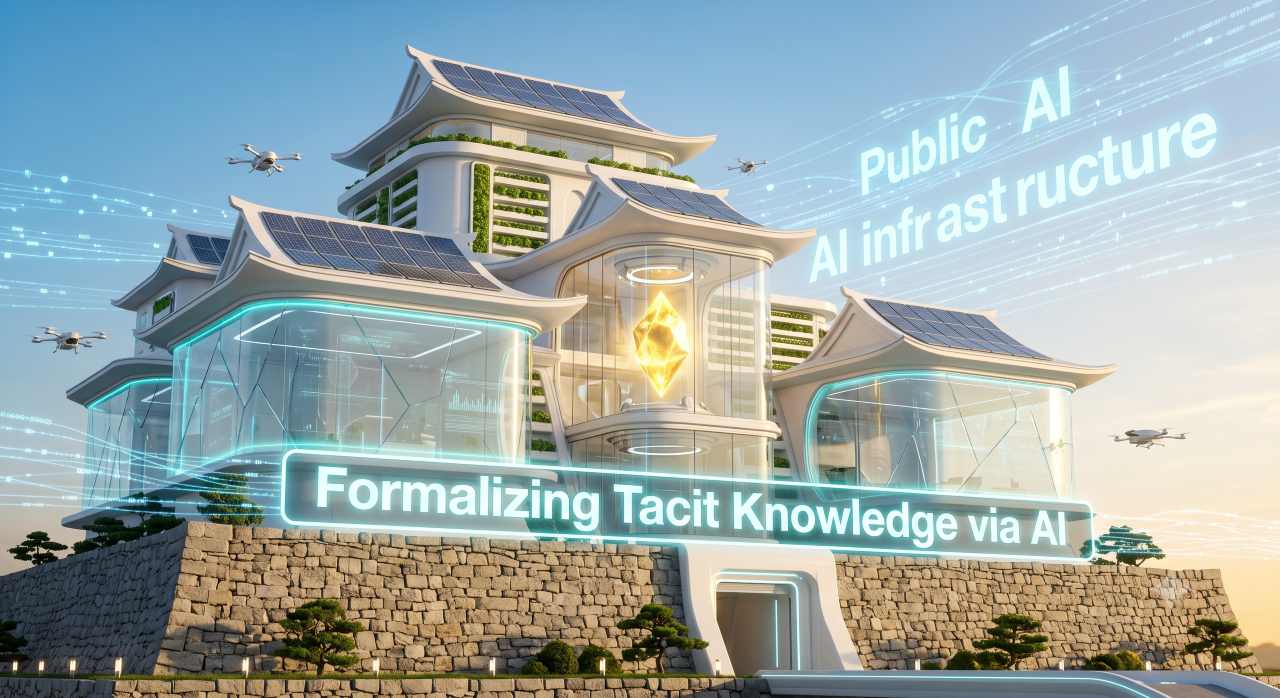
Author’s Note: The insights regarding technology and historical examples in this article are based on the perspective of an individual user (a business practitioner/consumer) who utilizes these convenient services in daily life and business operations. Please note that this is not an academic treatise by a macro-economist or a comprehensive analysis of the technical impact on social systems as a whole.
In the past, Amazon drastically improved our daily convenience by building a logistics system that delivers physical goods exactly when and in the quantities we need them. Similarly, Toyota’s “Kaizen” (continuous improvement) is globally renowned for its “Just-in-Time” philosophy, which minimizes the “Just-in-Case” excess inventory and produces only what is needed, exactly when it is needed.
Today, with the widespread adoption of AI, this revolutionary “reduction in lead time” is occurring in the realm of “knowledge and wisdom.”
In traditional education and business, the common approach was to spend vast amounts of time cramming knowledge into our heads, thinking, “This might be useful someday” (Just-in-Case). Inherently, while human beings (both physically and cognitively) can be highly proficient in specific fields, we are never omnipotent. That is precisely why we have desperately accumulated knowledge. Of course, this approach was not entirely in vain; broadening our horizons and touching upon diverse fields was a necessary process for identifying our aptitudes and discovering optimal career paths.
However, it is also true that this led to many cases where individuals hoarded “dead stock of knowledge” that was never used in actual practice, or became paralyzed by the sunk cost fallacy (“I spent so much time learning this”), making it difficult to adapt flexibly to new situations.
In contrast, modern AI has evolved into an omnipotent infrastructure (platform) to which we can completely offload “tedious processes” like complex searches and the collection and organization of vast knowledge systems. Because AI is software, it operates flexibly as long as there is an environment for it, whether on a local device (Edge AI) or in the cloud. We, as users, can now easily extract the desired output (wisdom) as a “single convenient service” without ever having to be conscious of the complex learning processes or search mechanisms behind the scenes.
As the lead time to access and formalize necessary knowledge has been dramatically reduced, we are gradually moving away from the need to “strive for omnipotence solely within our own minds and carry a heavy inventory of knowledge.” This article unpacks the changes brought about by AI’s formalization of tacit knowledge and explores how companies and individuals might protect and leverage their “unique competitive advantages” in a world where wisdom is easily commoditized.
Chapter 1: Upgrading the Knowledge Lineage and the Efficiency of the SECI Model
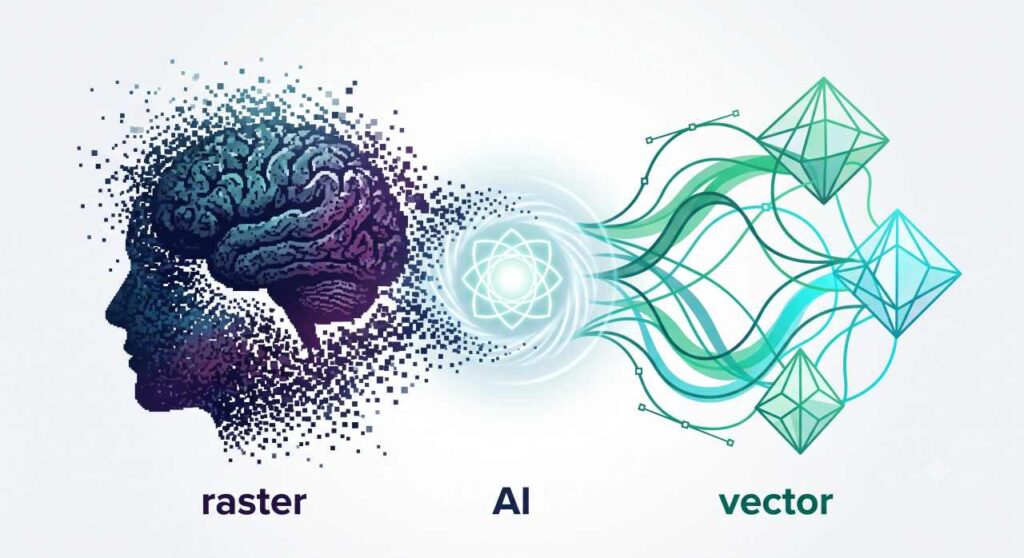
For years, a major challenge in the business world has been how to share “tacit knowledge” (smooth, intuitive knowledge systems that can be instantly put into action without verbal mediation). The “SECI Model,” advocated by Ikujiro Nonaka, represents the process of verbalizing (formalizing) an individual’s internal perceptions and rules of thumb through dialogue, and sharing them across an organization. However, there has always been a limit to this manual verbalization process. When humans formalize knowledge at a standard resolution, the components rarely link organically, often resulting in “rough, highly dependent manuals” that are difficult to execute in practice.
However, by utilizing AI’s high-resolution and precise verbalization capabilities, the situation has the potential to change dramatically. Components with fine granularity are represented while maintaining their organic relationships. Even if we expand horizontally (fusion with other fields) or vertically (diving deeper into a subject), the connections between fields tend to remain remarkably smooth.
This can be likened to the analogy of “raster” versus “vector” graphics. While human formalization (like a raster image made of pixels) often becomes pixelated and rough when enlarged, AI’s representation capabilities possess a scalability akin to vector graphics, maintaining smoothness regardless of how much you zoom in or out.
Note on the Metaphor: The term “vector” used here does not imply that AI’s internal mathematical vectors and design vector graphics are technically identical. It is used merely as an intuitive analogy to help visualize AI’s “organic and smooth representation capabilities,” distinguishing scientific objectivity from subjective impression.
Chapter 2: Historical Precedents – Technology Leakage and the Risk of “Knowledge Commoditization”

The ability to instantly formalize knowledge is not without significant risks. The Japanese manufacturing industry has historically learned this the hard way.
There is a history of highly advanced tacit knowledge, once held exclusively in the minds of artisans, being forcefully formalized and manualized by foreign capital utilizing abundant funds and rational systems. For instance, foreign companies would infiltrate factories—often by seizing management rights through capital participation or alliances—and thoroughly observe and video-record the artisans’ workflows, extracting those subtle movements and tacit techniques as digital data. Consequently, advanced technologies that were highly siloed domestically were directly transplanted to overseas factories, making them relatively cheap to reproduce (commoditization) and inflicting severe damage on domestic industries.
Reference: Historical Background of Technology Leakage
- Samsung Semiconductors succeeded thanks to Sharp’s technical support… The unimaginable arrogance of “Japanese electronics manufacturers” (PRESIDENT Online) (Article in Japanese)
- Case Studies: Guidelines for Preventing Technology Leakage (Ministry of Economy, Trade and Industry) (Document in Japanese)
However, this “commoditization of knowledge” is not entirely negative. From a practitioner’s perspective, the benefits of drastically reduced knowledge acquisition times and easy access to formalized knowledge are immense. Individual problems are solved rapidly, leading to an intellectual uplift where people can “tackle even more advanced problem-solving, assuming the knowledge base that AI has already learned.”
Chapter 3: Defense and Utilization – Domestic Companies Turning Tacit Knowledge into a “Source of Competitiveness”
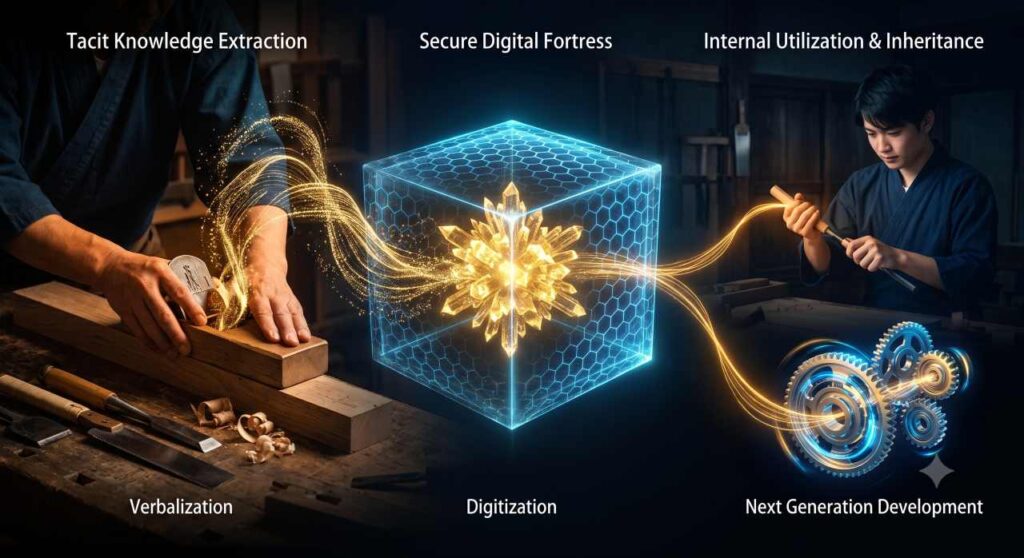
In response to the forceful wave of commoditization by foreign capital, there are notable examples of domestic companies properly managing tacit knowledge as explicit knowledge within their own organizations, utilizing it as a source of competitiveness.
They are using the very approach of “formalization through digitalization”—which once stripped them of their technology—as a shield to protect themselves. For example, some companies have used AI and IoT sensors to capture and formally structure the sensory techniques of veteran artisans (such as temperature control and applied pressure) into detailed data. Crucially, rather than leaving this extracted explicit knowledge defenseless and open to the public, they deployed it locally as “wisdom for training young talent and improving productivity within the company.” By doing so, they have succeeded in reducing dependency on specific individuals while staunchly defending their core technologies and artisans.
Reference: Success Stories in Digitizing and Formalizing Tacit Knowledge
- Daikin and Hitachi Begin Co-creation toward Establishing a Next-Generation Production Model Using IoT to Support the Transfer of Expert Technicians’ Skills (Daikin Industries News Release) (Article in Japanese)
- Dassai, one of the world’s finest sake – Why they brew sake using data (Mynavi News) (Article in Japanese)
Chapter 4: Unlearning and the “Cognitive Models” That Support Intelligence

To generate better value in the AI era, it will become increasingly important to flexibly update our own “cognitive models” through unlearning. However, this is not a simple dichotomy of “just throwing away old methods.”
The tacit knowledge and past success experiences built up by veterans are by no means mistakes; they function as a “solid stone foundation (masonry) that supports the new structures to be built above.” Without sharing a forward-looking perspective that respects this historical continuity and reduces friction between generations, it may become difficult to enhance the overall value of the organization. Organizations that cannot leverage this foundational knowledge might find themselves outmaneuvered by nimble and flexible competitors, quietly losing their market advantage before they even realize it.
Chapter 5: Governance and “Secure Dedicated Environments” to Protect Unique Competitive Advantages

In future organizational management, it seems we will be required to accurately grasp our strengths, weaknesses, and differentiators from competitors, clearly defining “what should be protected” and “what should be delegated to AI.”
For knowledge related to general operational efficiency, it is wise to actively reap the benefits of commoditization using public AI. However, regarding the handling of proprietary technologies and knowledge systems that serve as core differentiators, appropriate governance will likely be necessary.
When formalizing a company’s crucial tacit knowledge, it might be essential to build a “secure digital fortress”—a dedicated environment for the company. This could involve using secure corporate cloud environments or closed networks (private environments) completely isolated from the outside, ensuring that proprietary knowledge is not unintentionally used as training data by external platforms.
Conclusion: The Future We Must Draw on the Omnipotent Infrastructure of AI
The “reduction in knowledge lead time” brought about by AI is an incredibly convenient tool that exerts immense leverage when we think and solve problems.
By letting go of the “dead stock of knowledge” we once hoarded in our pursuit of omnipotence, and offloading processes to the AI infrastructure, we become lighter and more agile, able to respond flexibly to new challenges. At the same time, the solid foundation of “tacit knowledge” painstakingly built by our predecessors must be appropriately protected by secure, dedicated environments and governance to prevent it from being swallowed by the wave of commoditization, nurturing it as a unique competitive advantage.
No matter how much AI evolves, and even if all wisdom becomes provided as an ordinary infrastructure—as simple as turning on a tap—it is us, imperfect humans, who must ask “what problem should we tackle next?” and “what kind of future do we want to create?”, setting the trajectory for our progress.
Steadfastly protecting core technologies through governance, while utilizing the latest technology Just-in-Time to continuously challenge new value creation. This seems to be the most realistic and sustainable strategy we should envision on top of the omnipotent infrastructure of AI.



の教育への活用についてナラティブに語る|対話から感じる現代AIのポテンシャル|Expressio-300x200.jpg)
Comments