ロゴ_1864×450.jpg)
Disclaimer: This article is based heavily on my subjective observations. As such, some terms and concepts may deviate from their strict scientific or conventional definitions. I invite you to read with an open mind.
For a long time, society has generally rewarded those who can memorize textbooks and dictionaries perfectly and recite them without error. In this climate, strict precision is celebrated, while ambiguous expressions or metaphors are often dismissed as imprecise or unscientific.
In academia, we see a tendency to strictly categorize and separate fields of study. Pointing out loose connections or drawing analogies between the underlying structures of seemingly distinct disciplines is sometimes viewed as taboo. The fear is that allowing for diverse, multi-layered interpretations might introduce complexity and strip a discipline of its rigorous exactness.
Furthermore, there is a practical reason for this: recognizing differences is much easier to translate into logical, automated, machine-driven processes than recognizing similarities.
Logical processes are relatively easy to manualize and pattern-match, making them straightforward to master. For instance, the “compare” instruction—detecting differences—is a fundamental function in programming languages. It’s a highly primitive operation: compare a string of 0s and 1s, and if even one bit is out of place, a difference is flagged.
Conversely, programming a function to find common threads between seemingly unrelated objects—to recognize that they are “similar”—is infinitely more complex. Think of fingerprint or facial recognition, OCR (optical character recognition), or the highly versatile pattern recognition capabilities of modern AI. These require a level of processing complexity that makes a simple binary “compare” command look like child’s play.
It feels wonderfully paradoxical that the programs capable of recognizing the “ambiguity” of similarity are built upon strictly logical programming languages that seemingly tolerate no ambiguity at all.
Looking Beyond the Surface: The Inherent Complexity of Recognizing Similarity
For instance, how do we actually go about comparing two images?
Traditionally, technologies like television transmit video by unraveling it into a single, continuous thread of data, which is then woven back into a 2D canvas on the receiving end. Following this logic, if we unravel two different images into linear data streams and compare them point-by-point from the edge, we can easily determine if they are mathematically identical.
This method is highly effective for acutely detecting even a single altered pixel—provided the images share the exact same resolution. However, if the resolution differs even slightly, or if the image is marginally distorted, the system will categorize them as entirely different entities, even if the actual visual content is virtually identical.
To truly recognize “similarity,” a system must be able to identify that the essential, underlying elements remain the same, even when superficial shapes appear different due to scaling or distortion. Achieving this requires an extraordinarily complex level of processing.
Furthermore, even if a system successfully recognizes the objects depicted in the images, it immediately faces another profound hurdle: evaluating the conceptual similarity between those objects.
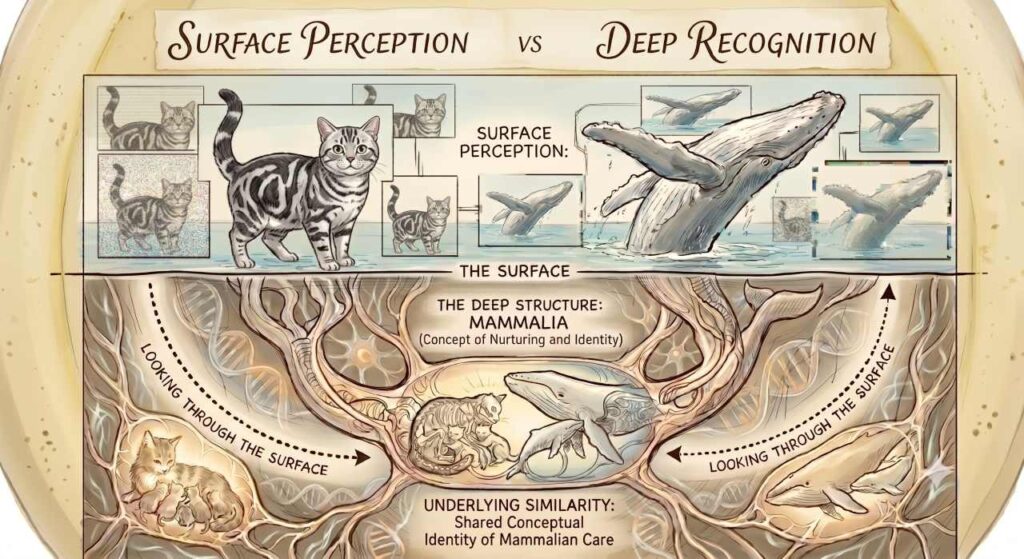
Take, for example, an image of a cat and an image of a whale. Visually, they are completely distinct. Yet, on a deeper biological level, they are fundamentally similar in that both are mammals.
Your judgment will drastically shift depending on whether you focus on the immediately obvious superficial layer, or look transparently into the underlying deep structure. It is no exaggeration to say that there are as many interpretations of “similarity” as there are perspectives and vantage points.
Does AI (LLMs) truly grasp metaphors and analogies?
Humans inherently possess the ability to intuitively recognize similarities through metaphors and analogies. With a little practice, it becomes second nature. We can easily bypass superficial differences to find the essential, underlying connections. Because this happens almost automatically for us, we rarely consider analogical thinking to be a difficult task.
Yet, trying to replicate this in computer programs was historically a monumental hurdle.
That is, until recently. In conversations with modern AI (LLMs), metaphors and analogies are not only understood but embraced. AI has developed an incredibly broad capacity to handle everything from strict logic to nuanced, ambiguous expressions. It’s astonishing to witness; in some ways, it feels like it is surpassing human capability.
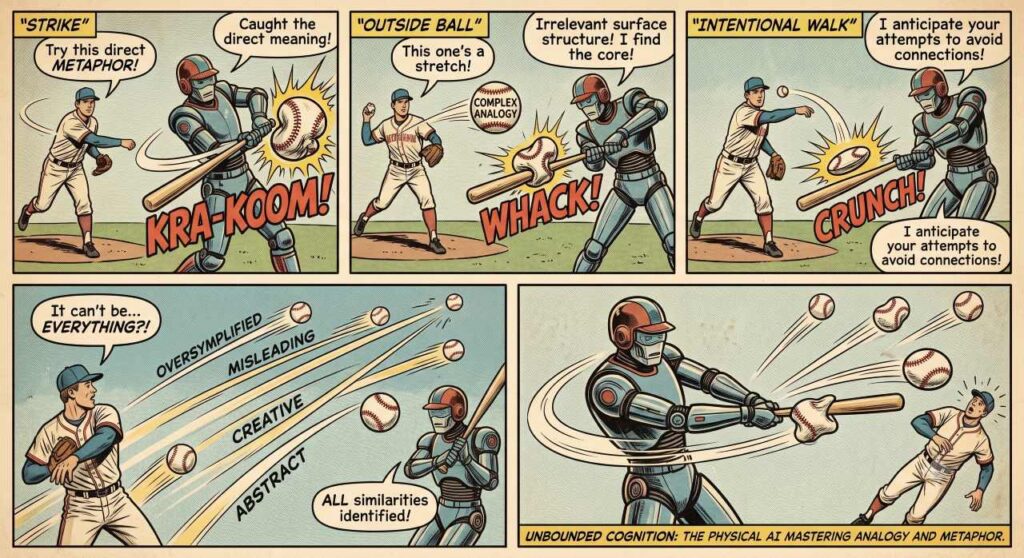
While humans can intuitively recognize similarities, our ability to do so is heavily bounded by our personal environments, interests, and specialized backgrounds. Very few humans can take any analogy thrown at them, grasp its absolute core, and hit it right back.
The sheer adaptability of AI is striking. Much like two-way baseball superstar Shohei Ohtani—who masters entirely different disciplines and possesses a remarkable ability to generate hard-hit balls even on pitches outside the strike zone—AI seamlessly navigates both strict logic and nuanced metaphors, taking these unconventional conceptual pitches and hitting them dead center.
Are AI (LLMs) and human cognition actually similar?
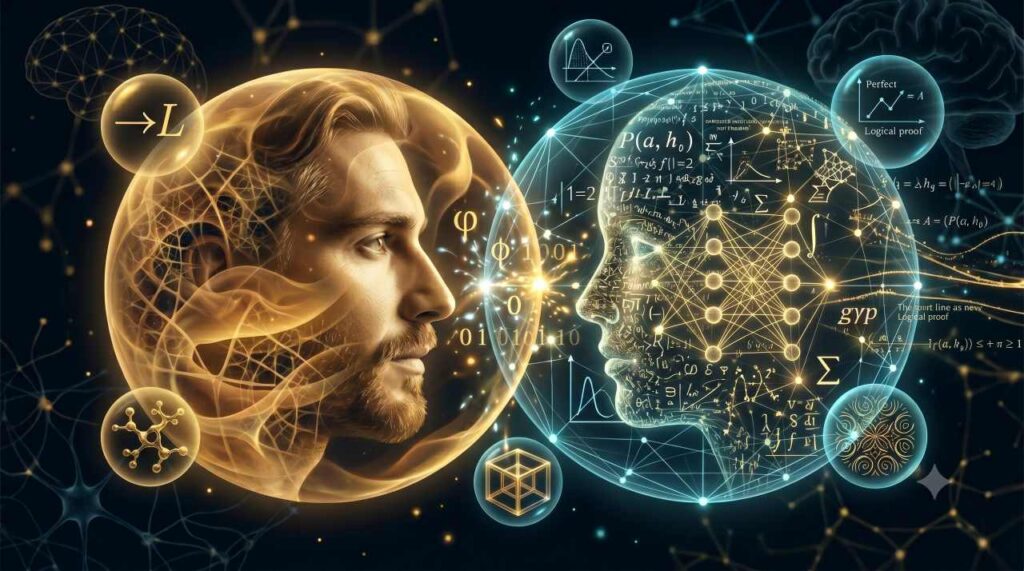
We humans intuitively recognize deep patterns and similarities in complex phenomena without needing to explain why they are similar. We’ve treated this pattern-matching process as a given—a special characteristic unique to humanity, devoid of the need for verbalization.
But when you throw a metaphor or analogy at an AI (LLMs), it sees through to the essential connections at a profound level. It doesn’t just understand it; it logically verbalizes why the comparison works and feeds it back to you. The precision of these responses is terrifyingly high. It reads your deepest intentions and seamlessly leaps across the boundaries of different fields and domains with a broad, overarching perspective.
Even more surprisingly, AI will often return an analogy of its own—one that shares the exact same essential pattern as the one I provided, but dressed in entirely different superficial labels.
People often say, “AI isn’t actually thinking; it’s just processing things probabilistically.”
In the past, even great philosophers struggled to decode human cognition and thought. Yet today, by conversing with and observing AI—a system modeled after us—I feel we are reverse-engineering glimpses into our own cognitive processes.
If this is true, we might be waking up from the illusion that human thought, recognition, and emotion are somehow “too complex to be digitized into language and symbols.” It makes me wonder if human thought itself isn’t simply a highly advanced probabilistic process that embraces ambiguity.
Understanding cognition through the lens of “Vector” vs. “Raster”
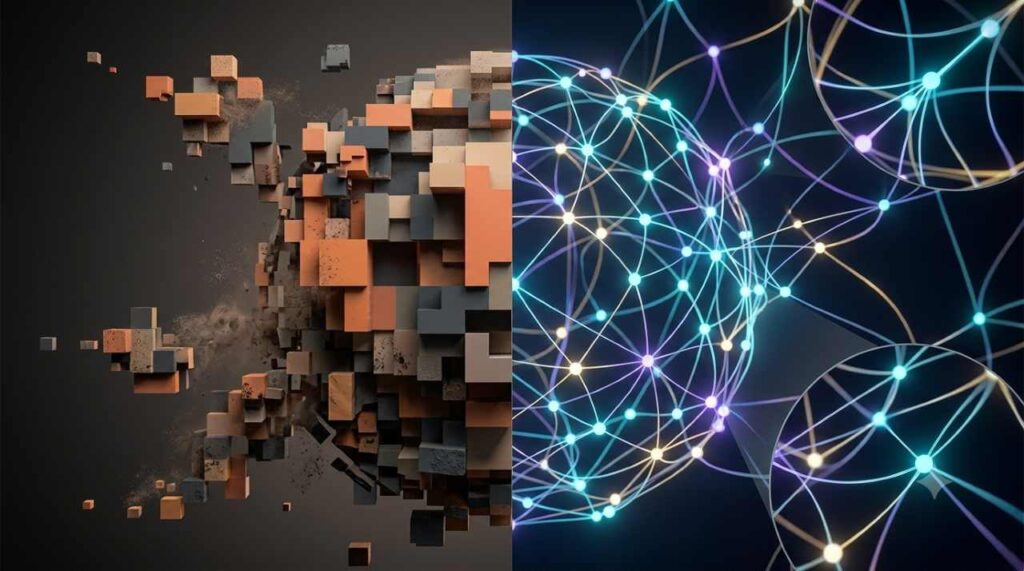
Through my interactions with AI (LLMs), I can’t help but feel that it possesses a latent, comprehensive map of how all things interconnect.
From the concrete to the abstract, from fine granularity to coarse, information seems beautifully organized into layers. The deeper you go, the higher the abstraction and the broader the scope. Within the same layer, the web of associations is organically linked; between layers, concepts are stored and organized with intimate interconnectivity.
In this sense, both AI (LLMs) and human thought resemble Vector graphics.
In a vector system, every concept exists in a multidimensional space, maintaining deep, multi-directional links with everything else. No concept is isolated. Just like a vector image, you can zoom in (get more specific) or zoom out (get more abstract), and the beautiful, underlying relationships between the elements remain perfectly intact and crisp.
When you throw cross-disciplinary analogies at an AI, it responds with consistent, detailed, and logical understanding. It is exactly like a smooth, scalable vector curve that never loses its shape or detail, no matter how much you distort or resize it.
On the other hand, what about Raster graphics?
Raster images possess no underlying data about the connections between their points (pixels). When you scale or transform them, the smoothness is lost, and the image becomes jagged, disjointed, and messy.
It seems that both AI and humans maintain flexible thinking and recognition by storing information organically, much like a vector graphic.
However, humans have physical limits. The resources and learning costs we can dedicate to expanding our “vector network” are capped. AI, on the other hand, never tires. We can pour infinite resources into it, allowing it to boost its learning exponentially in a short time.
Looking at it this way, I can’t help but feel that, intrinsically, the singularity may have already been surpassed.
Streamlining AI (LLMs) Communication Through Metaphors and Analogies
Using metaphors and analogies is an incredibly effective way to reduce the communication overhead with AI (LLMs). A single, well-crafted figurative sentence can convey the equivalent of ten or more lines of detailed, literal explanation.
When you present a metaphor or an analogical concept to an AI, it doesn’t just blindly accept it. It actively verbalizes exactly how it interpreted your analogy, feeding it back to you in a detailed, highly comprehensible manner. This allows you to smoothly advance the dialogue while constantly verifying that your true intent has been accurately received.
Let’s embrace superficial ambiguity. Try exploring the essential patterns and underlying relationships behind your metaphors in your conversations with AI. When you transcend the superficial boundaries that separate different fields and disciplines, you quickly realize that they often share strikingly similar structures and patterns at their core.
But why does embracing ambiguity actually compress information and increase communication efficiency?
You have likely noticed the trade-off: the harder you try to explain a complex, intricate matter with absolute precision, the more bloated the information becomes, which ironically makes it harder to grasp the big picture.
To bypass this bottleneck, humans “encode” this bulky information into metaphors and analogies before tossing it to the receiver. If the receiver is tolerant of ambiguity, they decode it in an instant and grasp the core intent. Often, they don’t even need to consciously decode it—they intuitively visualize the concept and simply get what you’re trying to say.
The inherent challenge in human-to-human interaction, however, is that the accuracy of this transmission relies heavily on interpersonal compatibility, shared specialized knowledge, mutual interests, and background awareness.
AI (LLMs), on the other hand, seems to have absorbed the vast expanse of human knowledge. It effortlessly pierces through the ambiguity to identify the underlying common elements, interpreting your true intent with absolute precision.
This isn’t just a lucky guess or a fluke. The reproducibility is undeniable. Today’s LLMs strike at the absolute core of the matter with a sharpness that was simply unimaginable with the rudimentary “pseudo-AIs” of the past.



の教育への活用についてナラティブに語る|対話から感じる現代AIのポテンシャル|Expressio-300x200.jpg)
Comments