ロゴ_1864×450.jpg)
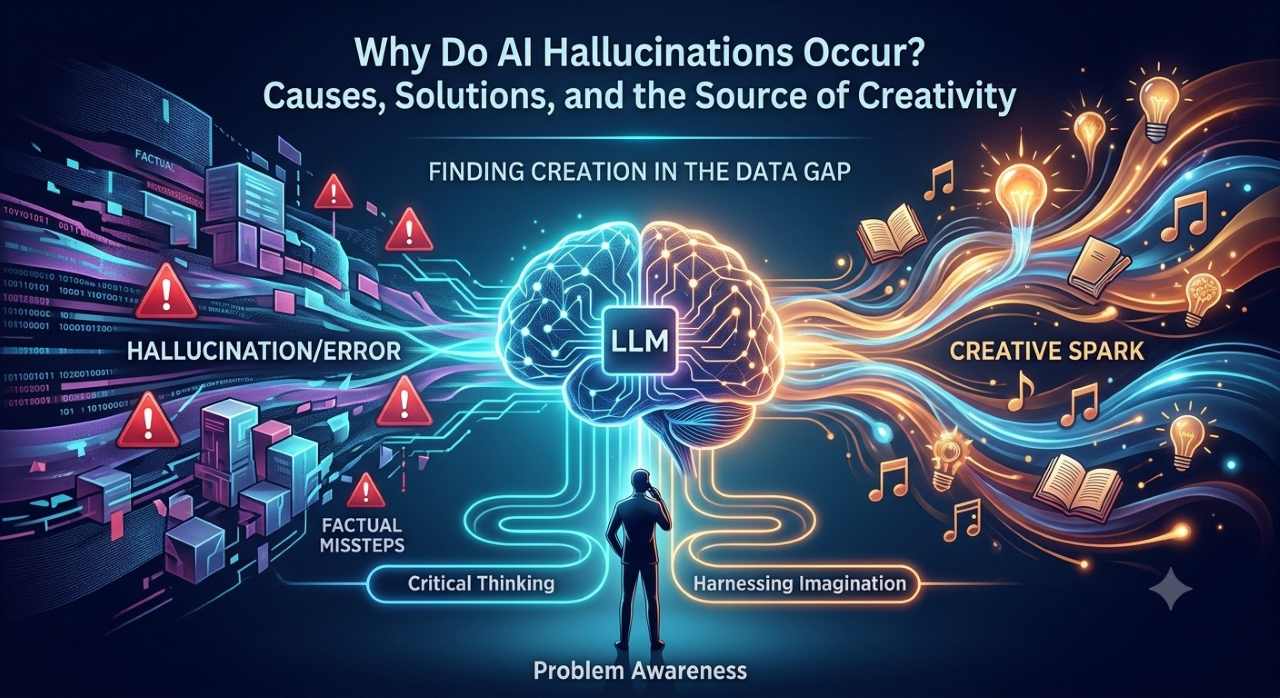
When interacting with AI (LLMs), we often find ourselves puzzled when they return answers that are clearly factually incorrect, or plausible-sounding lies that seem true at first glance.
It’s natural to wonder why these “hallucinations” occur. Understanding the causes can help us find solutions and use AI more effectively.
Hallucinations tend to happen when the AI is asked about topics it hasn’t been trained on, or when answers can’t be found even through web searches. However, I believe they also broadly occur in the following situations:
- Hallucinations caused by resource constraints
- Hallucinations depending on the user’s communication skills
In this article, I will share the causes and proposed solutions for hallucinations based on my daily interactions with AI.
By reading this, your distrust of AI hallucinations will likely soften. You may catch a glimpse of the AI’s human-like side and even feel a sense of familiarity with it.
Disclaimer: This article discusses my personal observations from daily interactions with AI. Please note that it is not intended to be a scientifically or academically objective paper.
Hallucinations Caused by Resource Constraints
I feel that AI hallucinations frequently occur when the resources (processing power) allocated to the AI by the service provider are limited, preventing it from performing at its full potential.
When user access to cloud servers spikes, resources aren’t infinite, so systems must inevitably impose limits to handle the load.
When the resources allocated to an individual AI are reduced, it might be forced to skip essential steps—like referencing the latest web information—and attempt to generate an answer solely through “inference within its pre-trained data,” which requires less computational cost.
If it creates vague premises through inference without verifying the underlying facts, the resulting conclusions will naturally be flawed. As a result, it returns impossible answers that are completely detached from reality (hallucinations).
It’s similar to humans: if we skip breakfast and lack energy (glucose), our brains don’t work as well. We unknowingly suffer a drop in performance and fall into short-sighted thinking. Similarly, when budgets or construction periods are strictly limited on a building site, the quality of the work often declines.
Phenomena similar to hallucinations commonly occur not only in AI but also in humans and social systems under certain constraints.
Solutions
If you sense a drop in quality likely caused by resource constraints, easing those constraints can lead to improvement.
Specifically, upgrading from a free AI service to a paid subscription, or moving to a higher-tier model (plan), can relax these limits. This is expected to reduce hallucinations and improve answer accuracy.
Hallucinations Depending on the User’s Communication Skills
Next is the case where the user’s prompts (instructions) are the root cause. Strictly speaking, this might not be a true hallucination, but there are many instances where a user perceives an AI’s off-topic answer as the “AI hallucinating,” when in reality, it deviated because of the user’s phrasing.
In the IT world, there’s a saying: “Garbage In, Garbage Out (GIGO).” No matter how excellent a system’s problem-solving abilities are, if the input is garbage (meaningless, low-quality information), the output will be worthless garbage. This perfectly applies to prompting an AI.
Even if the question you ask the AI makes perfect sense to you, if the expression is hard for the AI to understand, communication breaks down.
To get the AI to act according to your intentions, you need the skill to articulate your thoughts objectively, diluting your own biases. Check for any ambiguous parts or areas open to multiple interpretations within your prompt’s context. If it seems likely to mislead the AI, try rephrasing your question to clearly convey your intent.
Break Down Complex Tasks
If the problem is complex, don’t try to draw out the final conclusion in a single back-and-forth exchange. Break it down into multiple simpler problems and build the conversation step-by-step.
AI (LLMs) are highly intelligent and perceptive. By conversing carefully within the same context, the AI will pick up on your intentions—such as how deeply and broadly you want to explore, the desired specificity, and the level of abstraction—and provide highly accurate answers.
However, if the conversation gets too long and the topics scatter too widely, it can exceed the AI’s capacity to remember past context (the context window). The AI might enter an “amnesia-like” state and start giving strange answers. In such cases, it’s better to end that session and carry over the topic to a new, reset chat.
The Importance of “Critical Thinking”
Whether the cause is a lack of resources or inadequate prompting, it’s currently difficult to completely eliminate hallucinations in AI. That’s precisely why we, the users, strongly need “critical thinking.”
No matter how plausible the AI’s output looks, it’s vital not to swallow it whole as the absolute truth. Maintain a healthy skepticism: “Is this really true?” or “Are the premises correct?”
Practical Fact-Checking Techniques
When using AI daily, it’s good practice to make the following defensive measures a habit:
- Demand Sources or Citations:
-
Ask, “Please provide the URLs or book titles that form the basis of this answer,” and access the primary information.
- Always Corroborate with Web Searches:
-
For information involving critical decisions, don’t just stop at the AI’s answer. Always verify the facts using search engines.
- Cross-Check with Different AI Models:
-
Input the answer you got from ChatGPT into Claude or Gemini and ask, “Are there any errors in this content?”
It’s essential to view the AI as a “mirror reflecting your own thoughts” and an “excellent but occasionally lying assistant.” The ultimate responsibility for fact-checking always lies with the human user.
Are Hallucinations a Source of Creativity?
Right after emphasizing the importance of fact-checking, I also think about this: Is it always the right answer for even humans to simply say “I don’t know” when they don’t know something?
Even if we don’t know, isn’t it sometimes important to fully utilize our current knowledge and thoughts to “try creating our own answer,” even if it turns out to be wrong?
In the first place, if the word “creation” means to generate new things or concepts that have never existed before, then by definition, it is currently “unknown.” If we aren’t allowed to think about things we don’t know, creation would be impossible.
Actually, even in the technical mechanisms of AI, “creativity” and “hallucinations” are two sides of the same coin. AIs have a parameter (often called “Temperature”) that adjusts the randomness of their output. It’s known that increasing this value generates more diverse, novel, and “creative” text, but it simultaneously raises the risk of “hallucinations” that deviate from facts.
Solid reasoning based on detailed premises yields highly accurate results. However, to generate novel ideas like creativity, a process of expanding numerous ambiguous premises (hypotheses) and finding promising results among them is necessary.
Considering this, hallucinations might be likened to “a byproduct discharged during the process of combining massive hypotheses and powerful reasoning abilities to generate novelty.”
How to Intentionally Draw Out Creativity
By turning this characteristic to our advantage, it’s possible to intentionally utilize AI’s “hallucinations (= creative power).” For tasks without a single correct answer, AI becomes the ultimate brainstorming partner.
- “Give me 3 outlandish ideas that couldn’t possibly exist in reality.”
- “Temporarily ignore all common sense and existing frameworks, and freely form hypotheses.”
By deliberately casting prompts that remove constraints like this, you can draw out eccentric ideas that humans alone might not conceive, or fascinating fictional settings for sci-fi novels.
The Evolution of AI and Human “Problem Awareness”
Going forward, as AI models evolve and their training data becomes massive, malignant hallucinations representing factual errors are expected to decrease.
However, the more accurate AI becomes, the more a dilemma might arise where it only gives “boring, overly-perfect answers.” In the future, we will likely enter an era where we switch between “AI that answers accurately” and “AI that diverges creatively” depending on the task.
This is where the “problem awareness” that we humans possess ultimately becomes crucial.
No matter how much AI evolves to deliver facts accurately or generate eccentric ideas, having the starting point (problem awareness) of “What should we ask now?” or “What issue do we want to solve?” is a role only humans can fulfill.
Precisely because we engage in dialogue with clear problem awareness, we can think critically about the AI’s answers, and sometimes discover unexpected “seeds of creation” within its hallucinations.
What if, by fearing and over-suppressing AI hallucinations, we end up nipping the “buds of creativity” that AI possesses? While thoroughly verifying facts, we should firmly anchor our problem awareness and maintain the mental bandwidth to enjoy the AI’s uninhibited imagination.




の教育への活用についてナラティブに語る|対話から感じる現代AIのポテンシャル|Expressio-300x200.jpg)
Comments